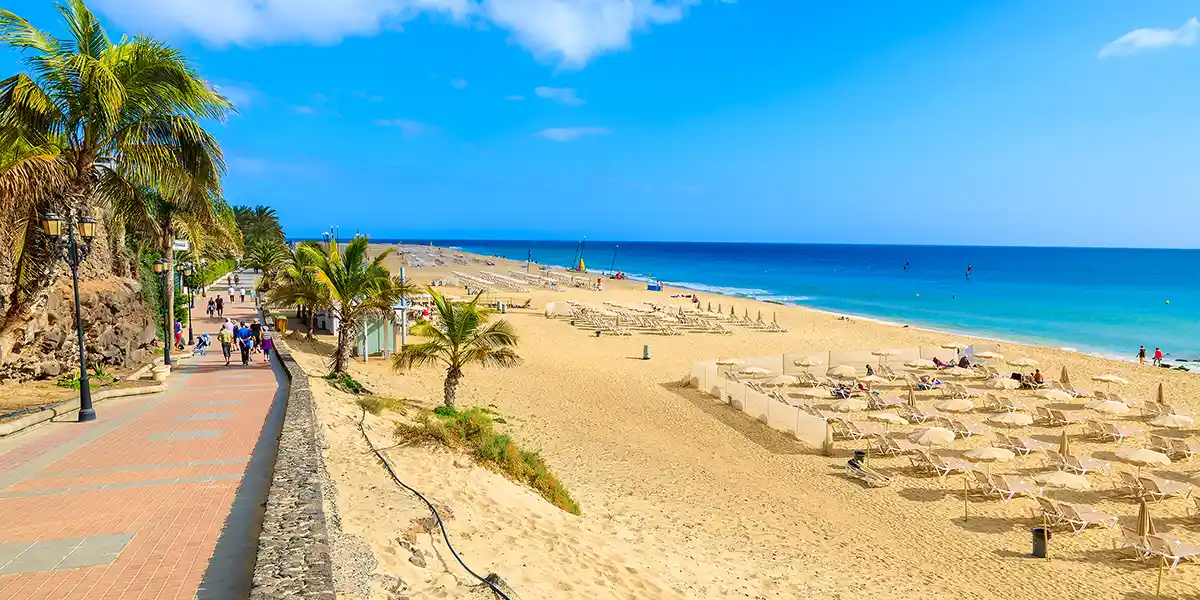
To arrive in Fuerteventura is to encounter a landscape defined by its horizontal vastness and a profound sense of openness. For the British traveller, arriving from the dense, vertical urbanism of the UK, the “Old Island” of the Canaries offers a dramatic shift in perspective. Its geography characterized by ancient, rolling volcanic hills and over 150 kilometres of white and golden sand doesn’t just provide a backdrop; it dictates the very rhythm of your journey. In Fuerteventura, the wind and the horizon are the primary navigators, turning every road trip into an exercise in geological discovery.
Many visitors begin their Saharan-influenced escape by searching for cheap holidays to Fuerteventura to experience the island’s legendary beaches and reliable sunshine. While the convenience of all inclusive holidays provides a perfect, stress-free anchor, the true essence of Fuerteventura is found in the movement between its north and south extremes. Choosing a coastal base satisfies the need for Atlantic breezes and relaxation, but the most rewarding moments occur when you head inland toward the “Malpaís” (badlands) or the silent, ochre-coloured mountains of the Betancuria Massif.
The secret to uncovering the island’s most evocative routes lies in a logistical approach that respects the varied terrain. All inclusive holidays. For those who want their journey from the shifting dunes of Corralejo to the wild, windswept beaches of Jandia handled with expert care, booking through Travelodeal ensures a seamless experience with professional logistical support. As the landscape shifts from volcanic plains to emerald-green valleys, the “touristic” pressure of the schedule begins to lift, replaced by a deep, resonant connection to a landscape that has been shaped by the elements for over 20 million years.
The Northern Pulse: Dunes and Volcanoes
The geography of the north is dominated by the Natural Park of Corralejo, a vast expanse of shifting sand dunes that spill directly into the turquoise Atlantic. Traveling through this area feels like navigating a mini-Sahara. The routes here are open and airy, leading toward the volcanic silhouette of Isla de Lobos. This is a landscape of light and movement, where the roads are often flanked by white sand on one side and the dark, craggy peaks of dormant volcanoes on the other, offering a striking study in textural contrast.
The Central Backbone: The Betancuria Massif
Heading inland toward the center of the island, the geography takes a dramatic turn. This is the oldest part of the Canary Islands, where the mountains have been softened and rounded by millions of years of erosion. The road to Betancuria the island’s ancient capital is one of the most scenic in the archipelago. Winding through deep ravines and past historic windmills, the route offers a sheltered, greener alternative to the coastal plains. It is a place of quiet dignity, where the “weight” of the geological history is palpable in every stone wall and terraced garden.
The Southern Wild: Jandia and the Barlovento Coast
The southern peninsula of Jandia is arguably the most dramatic geographical feature of the island. Separated from the rest of Fuerteventura by the “Istmo de la Pared” (the wall isthmus), it feels like a separate territory entirely. The Barlovento coast, on the western side of the peninsula, is a wild, untamed landscape of sheer cliffs and powerful Atlantic swells. Traveling here requires a slower, more deliberate pace, rewarding the unhurried explorer with views of the vast, untouched beach of Cofete, where the mountains drop vertically into the foam of the sea.
The Ritual of the Goat and the Cheese
Fuerteventura’s geography has also shaped its unique culinary identity. Because the arid interior is better suited to goats than cattle, the island has become world-famous for its Majorero cheese. Engaging in a local tasting at a farm in the centre of the island is the primary social and sensory ritual of the region. It is a reminder that the land is as productive as it is beautiful, and the best meals are the ones that celebrate the resilience of the local producers and the specific flavours of the volcanic soil.
Reflection on the Canarian Horizon
Fuerteventura serves as a reminder that the best travel experiences are the ones that offer a sense of space. It is a landscape that teaches you to appreciate the nuance in the wind and the value of a distant horizon. By the time you reach the end of your stay, you realize that the island hasn’t just shown you its beaches; it has offered you a new way to appreciate the raw, unadorned beauty of the earth. The horizon remains wide and inviting, promising that whenever you seek a sanctuary of light and stone, the old and beautiful soul of the Canaries is waiting to welcome you back.